
Ground source is the most efficient heating technology available for a home, and the hardest to get right. It needs proper ground investigation, a correctly engineered array, and drilling or excavation most installers simply aren’t set up for. It’s the technology we built this company around, and it’s still where we spend most of our time.
Prefer to talk it through first? Call 01271 850040.
Retrofitting homes across the South West
Since 2009
GSHPA member
Since 2016
MCS Accredited for
Ground source
We specify
Ecoforest ecoGEO+
Air source has become the default recommendation across the industry for a simple reason: it’s easier. A unit goes on an external wall, and the job’s largely done in a day or two. Ground source asks more of an installer before a single pipe goes in the ground. Thermal conductivity has to be assessed properly. The array, whether a borehole field, a horizontal trench, or a slinky coil, has to be sized against an accurate heat loss calculation, not a rule of thumb, or the ground itself will exhaust years into the system’s life and performance will fall away quietly, long after the installer’s moved on to the next job.
That’s the work most companies avoid. We don’t, because it’s where a ground source system earns its reputation as the most efficient heating technology on the market: a ground temperature that sits at a stable ten to twelve degrees year-round regardless of what the air’s doing outside, seasonal efficiencies that consistently beat air source, and none of the external unit, fan noise, or defrost cycling that comes with pulling heat from cold air.
An air source heat pump extracts heat from the outside air, even when that air is cold, and concentrates it to a usable temperature using the same refrigeration cycle as a fridge, run in reverse. A well-specified unit keeps working effectively down to around minus fifteen degrees, which covers essentially every winter this country produces.
The output a unit can sustainably deliver is expressed as its SCOP, seasonal coefficient of performance: the ratio of heat delivered against electricity consumed, averaged across a full year rather than a single test condition. It’s the number that actually predicts running cost.
That figure is specific to how the system is installed and controlled, not just which unit’s on the wall. Two identical heat pumps, sized and commissioned differently, will produce two very different SCOPs, and two very different bills.
01
Two houses of identical floor area can have completely different heating demands depending on insulation, glazing and how rooms are used. We size against the real figure, not an assumption.
02
Radiators or underfloor heating need to run at a flow temperature the heat pump can deliver efficiently. Where that’s not the case yet, we say so at survey stage, not after installation.
03
Not specified in isolation. An air source system that’s part of a wider energy setup runs meaningfully cheaper than one bought as a standalone product.
04
Not an afterthought once something’s gone wrong. A heat pump maintained annually holds its efficiency for decades; one that isn’t loses it quietly.
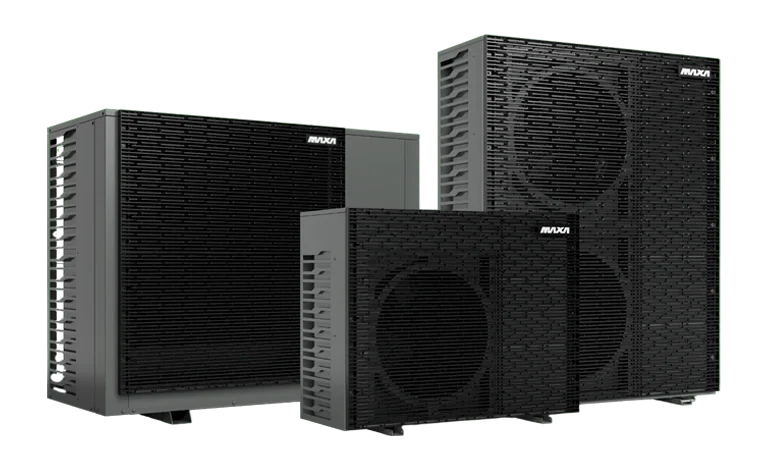
A flagship R290 monobloc range with genuine fossil-fuel-replacement performance, rated to deliver at outdoor temperatures most manufacturers’ spec sheets quietly avoid mentioning.
Flow temp
Rated to
Low GWP
Ken shares his experience of installing a ground source system into a listed farmhouse, where the constraints of a protected building made specialist design essential rather than optional.
Boiler Upgrade Scheme grant, available towards a qualifying ground source installation, plus 0% VAT on qualifying work. Ground source vouchers run for six months once approved, longer than the three months given for air source, which matters given the additional groundworks lead time.
Boiler Upgrade Scheme grant — towards an air or ground source heat pump, plus 0% VAT on qualifying work.
Either can work; it depends what the site gives us. A horizontal array needs roughly three to four times the property’s footprint, so it suits larger gardens. Where that’s not available, one or more boreholes reach stable ground temperature at depth on a much smaller surface footprint, at a higher drilling cost. The ground investigation tells us which makes sense before we recommend either.
The ground stays close to a constant temperature year-round, so the heat pump isn’t working against a swinging outdoor air temperature the way an air source unit is. That generally means better efficiency through the coldest months, no external unit or fan noise, and no defrost cycling. Air source remains the right call where land or borehole access isn’t there.
Performance falls away gradually rather than failing outright, which is part of why it’s a common issue that goes unnoticed until a system’s a few years old. The ground gets drawn down faster than it can recover between heating seasons. Getting the sizing right from a proper heat loss calculation, not an estimate, is the single biggest factor in avoiding it.
Existing homes take it well, provided the site has the space or borehole access and the emitters can run at a low flow temperature. Listed and period properties are often assumed to be unsuitable; in practice they’re some of the projects where specialist design matters most, not a reason to rule it out.
Longer than air source, generally. Ground investigation, array design, and drilling or excavation add weeks that an air source install doesn’t need. It’s a fair trade against a heating system built to run efficiently for thirty years rather than the fifteen or so typical of an air source unit.
In-house. Groundworks are coordinated by the same team responsible for the design, rather than passed to a separate contractor working from someone else’s specification.
Servicing isn’t limited to systems we installed. If yours is due an annual service, running below par, or needs a repair, our service team can take it on, whoever fitted it originally.
Annual servicing to keep warranties valid and the system running at the efficiency it was designed for.
Something not performing as it should? We’ll identify what’s actually wrong before recommending any work.
Parts and labour repairs, including systems installed by other companies.
We maintain most major brands, including;
Ecoforest · Mitsubishi · Vaillant · Viessmann · Daikin · Samsung · Clivet · IDM
Based on 210+ review on Trustpilot







Whether ground source suits your site depends on land, geology and how the property’s heated now. Tell us about the project, or book a design survey directly and we’ll assess it properly.
Prefer to talk it through first? Call 01271 850040.